

Monty Python and the Grail Fail
School-Boy Humor to Distract from the Bankruptcy of Inquiry

Absurdity as a Distraction from Anguish

“Well, I’ve always said, there’s nothing an agnostic can’t do if he really doesn’t know whether he believes in anything or not.” — from a Monty Python sketch.
Who, growing up in the 1970s in America, did not watch Monty Python’s Flying Circus? Enamored of its wit and verve, many young men memorized, as did I, the sketches; repeated them ad nauseam with friends at parties; and can recall them even today. (I do not know of any young woman at the time who cared for them.)
50 years later, Book Shop and The Bishop still amuse me wonderfully. But this week, a profound, unobvious aspect of their humor revealed itself to me; or, perhaps, I have reached an understanding that they could not reach, which their comedy meant to dispel. Aside from the gags, Monty Python represents the failure of inquiry to reveal meaning.
Michael Palin explained in retrospect that the group’s humor made light of the absurdity of life. (I do not find life absurd in the least.) Indeed, I see the Pythons now in my mind’s eye tied at the hip with the Existentialists, both careening into the abyss; whereas the Existentialists wail and moan, the British schoolboys cackle and guffaw, all the way down. If one must choose, Monty Python offers the preferable comfort of a distracting laugh. Absurdity is the fallback position, keeping nihilism at bay. “Rage, rage against the dying of the light” or parry with one’s wit, a deflection of inevitable hopelessness.

Why the Holy Grail?
The filmmakers of Monty Python and the Holy Grail (1975) must have assumed that English public schoolboys would know of the Grail, but they could never have anticipated the film would blow up good, as Billy Sol Hurok used to say, in the US of A. When I saw the film in 1977, I, an American prep school teenager, had never heard of the Grail. Thus, I understood it, from the film, to be a fruitless quest for a tin cup.
Nothing could be further from the truth. During medieval times, the search for the Grail was an inquiry, often lasting a lifetime, for transcendent meaning.
The other day, at a bookshop in New Orleans, on the bottom shelf of the throwaway rack in front of the store,1 I found this marvelous travelogue for 25 cents:
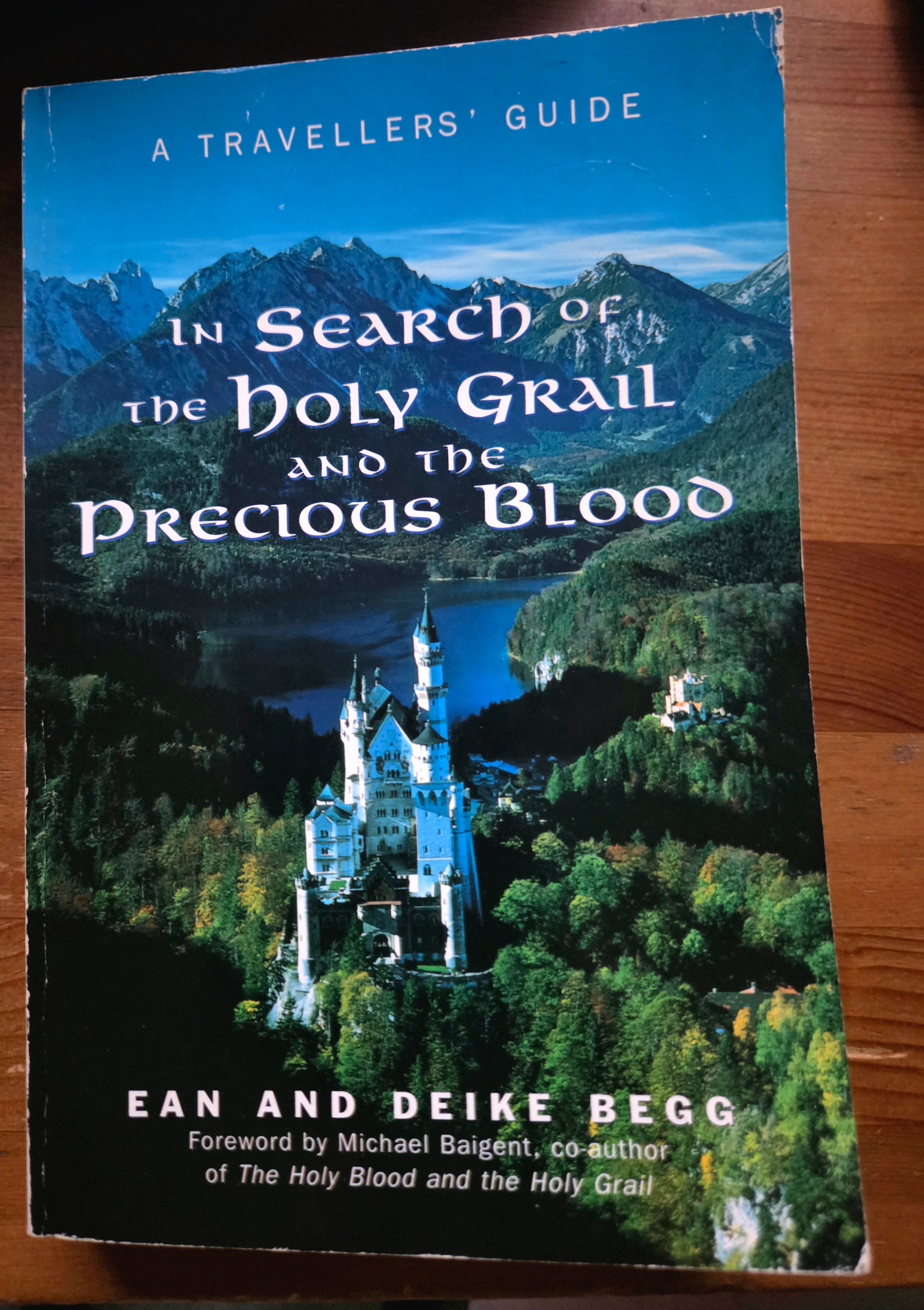
The Holy Grail: what magic the name conjures up even for those who have forgotten its story. It is the ultimate quest and the one that most characterises the adventurous spirit of the West. It has become a metaphor for all that is most desirable and hardest to achieve.2
As the film describes it, the search for the Grail is a fruitless quest for a mirage. Its questors are backwards pre-modern characters, including King Arthur and his Knights of legend, who prove to be ludicrous, as they pursue their unreachable goal and bumble through the kooky happenings they engender and encounter along the way.
The Beggs, both Jungian psychotherapists, elaborate upon the historical search for the Grail:
The many versions of the Grail legend are too diverse to summarize, but the main elements are these:
Something has gone wrong. The world has run out of meaning and it is women who first sense this. The old king, standing for the established order, is impotent and the land is waste.
A youthful hero, typically an orphan, is destined to find the Grail, heal the old King and take his place. Two or three other chosen ones may share his vision and his quest. The Grail is glimpsed and then lost because a vital question has not been asked. This may be a failure of compassion in which the hero neglects to ask the Old King what he is suffering; or it may be a failure of understanding what the Grail is for and whom it serves.
The Grail itself is active. Something is operating in human lives that transcends conscious intentions. It names those who are to be its servants and leads them on their individual quest. It designates the high places where its presence will be commemorated and is the architect of the Grail castles and temples.
There is a fellowship or family of the Grail who continue to further and protect its interests in the world.3
The historical quest for the Grail is a quest for meaning in life. The film, of course, touches on none of the profounder aspects of the historical Grail, but rather to send it all up as a “chalice from the palace” farce. Arthur’s “Lady of the Lake” speech, delivered with a kind of awe is followed by the ridicule of a muddy anarcho-syndicalist peasant as “a watery bint lying about in ponds.” Great fun for the boys in the sixth form. The lines still tickle what is left of the teenager in me.
Yet philosophical, scientific and political subjects are indeed broached in the film — and when listened to without permitting the characteristic humorous delivery to influence one’s hearing of it, one gets the sense of an intense, yet hidden desire to actually have these pressing questions answered. The once esteemed, valiant heroes of the English fight, kill and die in the film, but for what?
Their quest elicits no answers. No Grail is found, for, in this film, not only are the men not up to the rigors of the task of finding it, but there is no Grail to be found. This, the quest for it, and thus for a transcendent meaning of human existence, is as silly as the gags are. Inquiry fails; meaning is meaningless.
At its end, the film jumps forward from its medieval setting to conclude abruptly in modernity: Police in cars arrive to arrest the actors for the death by sword during filming of an elderly academic. This filmic absurdity resolves the scriptwriter’s inability to make the film meaningful. You see, the filmmakers knew they were guilty when they made the film. They arranged their own sentences. They are condemned.
That is how I have come to understand this film’s dispiriting denouement, the finalé that, as I recall, let all the air out of the cinema and left me and my buddies questioning all of the laughter that preceded it.
I still dislike that ending — especially the brutal throat-slashing of the elderly historian character interviewed in the film about his own life study of the Arthurian legend — but I understand why, to the filmmakers, no other ending is possible.
They could have let the historian live, but the anger, suffused elsewhere in much of Python, that their search had come up empty-handed was so desperate that they ordained that his character must be murdered in front of his wife. A shocking indignity that compares very badly, to the detriment of the scriptwriter, with the comic deaths in the rest of the picture.
The gags are still great. “Come back, you bastard, and I’ll bite you to death!” “The Holy Hand Grenade of Antioch” and, of course, “RUN AWAY!” But I must conclude that the film is no more than a laugh track to existentialism. There’s no there, there, because no “there” was ever posited.
The Existentialists, for all their philosophizing, learned nothing, arrived at no conclusions, contributed nothing to the world. But as moderns, nominally “progressive,” they were still convinced of their own superiority to that which and those who came before.
Monty Python and the Holy Grail, in fact, ridicules the medieval from precisely this pedestal-high vantage point. The humor works to reduce the pompousness to a diaphonous fiction of humility. King Arthur says, “Sir Bedivere, this new learning amazes me. Tell me again how ram’s bladders may be used to prevent earthquakes.” You see, we moderns have “science!” Just think of what modern “science” has done to the world in the past five years.
The Existentialists were certain only of this, that the search for meaning is fruitless. Yet, for all that nothing which nothingness is worth, they felt compelled to shout it out to the whole world — the publishing royalties made meaninglessness all the more endurable for them, surely — and the world listened enraptured for a time to their Siren song, much to our disadvantage. That world, and our patience with the meaningless abstractions the Existentialists and their acolytes drummed up into the whirlwind of fame they enjoyed for fifty years, is finally, thank goodness, over. The Pythons will be remembered long after the Existentialists have been forgotten. The Pythons were part of it, but they made it, at least for 90 minutes, funny.
I have been buying books for 50 years. In my experience, it is rare to find modern British imprints on a store bookshelf anywhere in this country. Perhaps a British traveler on vacation to The Big Easy arrived with this title in his luggage or a visiting scholar to Tulane with his library. Regardless, it is a real treasure for me, since it has helped me to close a door that needs shutting and opened a gate of discovery for me.
Begg, Deike and Ean, In Search of the Holy Grail and the Precious Blood, London: Thorsons, 1995, ix.
Ibid., ix-x.
I enjoyed this Mr. Kuslan, I was not a big fan of Monty Python but my buddy was, and he dragged me to see "Holy Grail" and "Life of Brian" way back when in the theatre. I think I fell asleep in "Brian." So, now that I read your essay, I'm going to believe that my 17 year old self was just looking for meaning! Ha! Take care.
P.S. while you're on the subject of teenager humor, maybe the next essay will be on "Austin Powers."
Please call me Rich. I saw Life of Brian as well. Some funny scenes, as well, but, yes, it is the same thing. Austin Powers was just silly and harmless. The difference between them is that there is some love in it, which makes the character, at times, adorable, but there is no love in Python.